How Much Money Do You Need to Retire Comfortably in India?
Estimate your retirement corpus, understand the impact of inflation, find out how much to invest each month, and avoid the common planning mistakes. Includes a free calculator.
Key Takeaways
- No single corpus suits everyone. Your target depends on expenses, retirement age, inflation and other income.
- A rough starting point is 25 to 30 times your annual retirement expenses (in today's money).
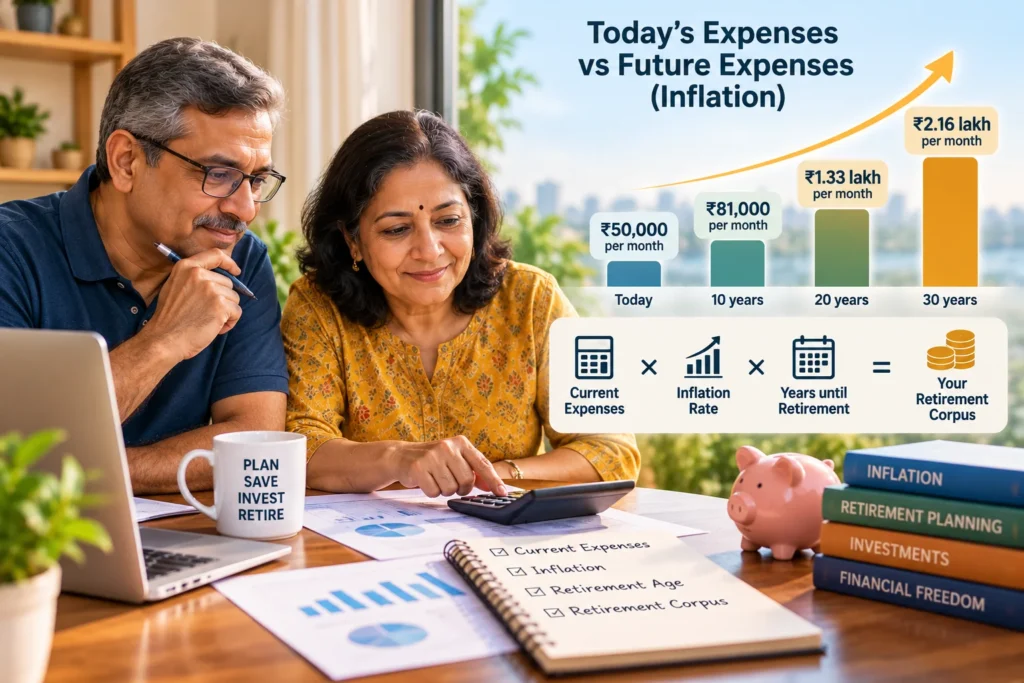
- Inflation can change your target dramatically: ₹50,000 a month today could need about ₹2.16 lakh after 30 years at 5%.
- Start early, test several return scenarios, and review your plan every year.
How Much Money Is Enough to Retire?
Imagine reaching the age of 60 after spending 35 years working, earning a salary, supporting your family and paying your bills. You finally have the freedom to leave your job, spend more time with loved ones, travel and enjoy the life you have worked hard to build.
But there is one important question: where will your monthly income come from after retirement?
Your salary may stop, but your expenses will continue. You will still need money for groceries, electricity, healthcare, household maintenance and other everyday needs. If you have dependants, their financial requirements may continue as well. This is why retirement planning should begin long before your final working day.
For some Indian households, a retirement corpus of ₹1 crore may provide a useful starting point. For others, ₹3 crore, ₹5 crore or even more may be necessary. The right amount depends on your current expenses, retirement age, expected lifestyle, inflation, healthcare requirements, existing savings and other sources of income.
There is no single retirement corpus that guarantees a comfortable life for everyone in India. However, you can estimate your target using a few practical calculations.
In this article, we will explain how to calculate your retirement needs, understand the impact of inflation, estimate how much to invest each month and avoid common retirement-planning mistakes.
1. How Much Money Do You Need to Retire Comfortably in India?
Your retirement corpus is the total amount of money and investments available to support your expenses after you stop working. The amount you need depends primarily on how much you expect to spend and how long your retirement may last.
For example, consider two people retiring at the age of 60. The first owns a fully paid-off home, has modest living expenses and receives a pension. The second rents a home, supports dependent family members and has no pension. Even if both retire on the same day, their financial requirements may be very different.
A useful starting point is to estimate your annual retirement expenses and multiply them by an appropriate planning factor. A commonly used rule of thumb is to begin with approximately 25 to 30 times your expected annual retirement expenses. This is only a rough screening method, not a guarantee that your money will last throughout retirement. The appropriate target depends on investment returns, inflation, taxes, withdrawal patterns and retirement duration.
An illustrative retirement corpus guide
| Monthly retirement expenses (today's money) | Annual expenses | Rough corpus at 25× | Rough corpus at 30× |
|---|---|---|---|
| ₹25,000 | ₹3 lakh | ₹75 lakh | ₹90 lakh |
| ₹40,000 | ₹4.8 lakh | ₹1.2 crore | ₹1.44 crore |
| ₹50,000 | ₹6 lakh | ₹1.5 crore | ₹1.8 crore |
| ₹75,000 | ₹9 lakh | ₹2.25 crore | ₹2.7 crore |
| ₹1,00,000 | ₹12 lakh | ₹3 crore | ₹3.6 crore |
These figures express the rough corpus in today's purchasing-power terms. They do not automatically include the additional amount required to account for inflation before retirement.
For example, if your present household expenses are ₹50,000 per month, a rough starting target might be ₹1.5 crore to ₹1.8 crore in today's money. If you are retiring decades from now, you must adjust that amount for future inflation. That distinction is essential to building a realistic retirement plan.
2. Why Inflation Can Change Your Retirement Target Dramatically
One of the biggest mistakes in retirement planning is assuming that today's expenses will remain the same in the future. Inflation gradually reduces the purchasing power of money. As prices rise, the same amount buys fewer goods and services.
Suppose your household spends ₹50,000 per month today. If average inflation is 5% annually, the amount needed to maintain a similar level of spending will increase over time.
| Years from today | Approximate monthly expenses at 5% inflation |
|---|---|
| Today | ₹50,000 |
| After 10 years | ₹81,400 |
| After 20 years | ₹1.33 lakh |
| After 30 years | ₹2.16 lakh |
Mathematical projections assuming a constant 5% annual inflation rate, not predictions of actual future inflation.
The difference is significant. A person who expects to retire 30 years from now may need approximately ₹2.16 lakh per month to cover expenses that cost ₹50,000 today, under this assumption. This is why it is dangerous to plan retirement using today's prices alone.
India's National Institute of Securities Markets (NISM) provides a retirement-planning calculator that allows users to account for inflation, retirement age, expected investment returns and existing savings. Open the NISM calculator →
3. Calculate Your Retirement Corpus Step by Step
You do not need to be a financial expert to begin estimating your retirement needs. Start with the following steps.
Step 1: Calculate your current monthly household expenses
Include the expenses you expect to continue after retirement, such as:
- Groceries and household necessities
- Electricity, water, phone and internet
- Housing maintenance or rent
- Healthcare and insurance
- Transport and vehicle maintenance
- Support for your spouse, parents or other dependants
- Travel, leisure and personal spending
- Other regular household commitments
You may no longer have certain work-related expenses after retirement. However, healthcare, leisure and home-maintenance expenses may increase. Avoid assuming that every expense will decrease once you stop working.
Step 2: Estimate your retirement age
Your retirement age affects both the amount you need to accumulate and the number of years available to invest. Someone planning to retire at 50 has fewer earning years and may need to fund a longer retirement than someone planning to retire at 60 or 65. If you expect to live well into your 80s or 90s, your plan should account for a potentially long period without employment income.
Step 3: Adjust your expenses for inflation
Use a reasonable inflation assumption to estimate how much your present expenses might cost at retirement. For example, at an assumed 5% inflation rate, ₹50,000 per month today becomes approximately ₹2.16 lakh per month after 30 years. Your actual expenses may grow at different rates. Medical expenses, education-related support and housing costs may not follow the same inflation pattern as general household spending.
Step 4: Account for other retirement income
Your retirement needs may be partly covered by:
- EPF or other retirement benefits
- NPS savings and applicable retirement benefits
- An eligible pension
- Rental income
- Other financial assets or reliable income sources
Do not count the same asset twice. Also, distinguish between income you can reasonably rely on and income that may fluctuate.
Step 5: Estimate the corpus you need
A simple first estimate is:
You can then inflate that amount to your expected retirement date.
These are not personalised retirement targets. A more detailed projection should model the number of retirement years, investment returns during retirement, taxes, withdrawal rates, existing assets and other income.
4. Retirement Calculator: Estimate How Much You May Need
The calculator below offers a simple estimate using your current monthly expenses, current age, expected retirement age and an inflation assumption. It calculates the future value of your current annual expenses and applies a rough planning multiple to estimate a retirement corpus.
Your retirement estimate
Change the values below to see how your retirement target changes. Amounts are illustrative and are not investment recommendations.
Enter only assets set aside for retirement, not emergency savings or money already committed to other goals.
Important: This calculator is a rough screening tool. It inflates today's expenses and applies a planning multiple; it does not model investment growth, returns during retirement, taxes, withdrawals, pension income or the actual duration of retirement. Existing savings are adjusted for inflation only to express them in future purchasing-power terms; this is not a projection of investment performance. A detailed retirement plan may produce a different result.
For a more complete estimate, use the official NISM Retirement Planning Calculator. It includes assumptions about investment returns, retirement duration, current savings and retirement benefits.
5. How Much Should You Invest Every Month to Retire Comfortably?
Once you estimate your target, the next question is how much you need to invest every month to reach it. The answer depends on how many years remain before retirement, the investments you choose, their actual returns, the fees and taxes involved, and whether you increase your contributions as your salary grows.
Consider a hypothetical example. A person aged 30 wants to retire at 60. They have 30 years to build their retirement savings. If their retirement target is ₹6 crore, they need a strategy for accumulating that amount over three decades.
The following table shows the approximate monthly contribution required to reach ₹6 crore over 30 years under different assumed annual investment returns, using monthly contributions made at the end of each month and a constant monthly-equivalent return.
| Assumed annual return | Approximate monthly investment |
|---|---|
| 6% | ₹29,900 |
| 8% | ₹17,700 |
| 10% | ₹9,600 |
| 12% | ₹5,000 |
Mathematical illustrations, not forecasts. They do not account for taxes, fees, inflation adjustments or changes in contributions.
The monthly-equivalent return convention means the assumed annual return is converted into a monthly rate for the calculation. Actual investment returns fluctuate. The difference between the rows shows why assumptions matter so much. A higher assumed return can make the required contribution appear much smaller, but it also introduces uncertainty and potentially greater investment risk.
It would be unwise to plan your retirement on the assumption that you will consistently earn 12% every year. A more robust plan should test several return scenarios and consider what happens if actual returns are lower than expected.
Why increasing your SIP over time can help
Your salary may increase as your career progresses. Instead of maintaining the same investment amount forever, you can review your contributions whenever your income rises. For example, you might begin with a manageable monthly investment and increase it as your salary grows, provided you have adequate emergency savings and can afford the contributions. This can help you direct more money towards retirement without requiring an unrealistically large contribution from the beginning.
6. Where Should You Invest for Retirement in India?
There is no single investment product that suits every retirement plan. Your choice depends on your age, retirement horizon, risk tolerance, liquidity requirements, existing investments and other sources of retirement income.
Eligible salaried employees may accumulate retirement savings through EPF contributions. Review your current balance, future contributions and the applicable rules when estimating how much of your goal may already be funded. Do not assume that your current EPF balance alone will be sufficient for retirement.
A retirement-oriented system regulated by PFRDA. Depending on the applicable rules, scheme choices and withdrawal conditions, NPS may form part of a long-term strategy. Understand its charges, tax treatment, investment options and withdrawal rules. PFRDA provides planning information and tools, including the NPS Prosperity Planner.
Can provide exposure to equity, debt and other market-linked investments, depending on the scheme. For investors with a long horizon, a suitable diversified portfolio may play a role, but market-linked investments can lose value and returns are not guaranteed. Choose by time horizon and risk tolerance rather than chasing recent performance.
May have a role in preserving money for nearer-term needs or balancing investment risk. Compare interest rates, liquidity, taxation, premature withdrawal rules and applicable protections. Avoid placing all retirement money in one product without considering inflation and the need for growth over a potentially long retirement.
SEBI's investor education guidance recommends considering diversification, investment goals, risk and inflation when planning for the future. A retirement portfolio should not depend entirely on one company, one asset class or one investment assumption. For further reading, visit SEBI Investor: Plan Early for Retirement.
7. What Expenses Should You Plan for After Retirement?
A retirement plan should reflect how you expect to live, not merely how much money you hope to accumulate.
Housing
If you own a fully paid-off home, you may not need to budget for rent. However, maintenance, repairs, property-related costs and utilities will continue. If you expect to rent, include rent increases in your projections.
Healthcare
Healthcare is one of the most important uncertainties in retirement. Medical expenses, medicines, tests, hospitalisation and care requirements can change substantially as you age. Your plan should account for insurance coverage and potential out-of-pocket expenses. Do not assume that health insurance will cover every medical cost.
Food and everyday living
Your grocery budget may change after retirement, but food and household essentials will remain recurring expenses.
Travel and leisure
Retirement may give you more time to travel, pursue hobbies or spend time with family. Include these activities if they are part of your idea of a comfortable retirement.
Support for family members
Some Indian households continue to support children, parents or other relatives after retirement. If you expect these responsibilities to continue, include them in your planning instead of assuming that all family-related expenses will disappear.
Unexpected expenses
Maintain an accessible reserve for emergencies. Your retirement portfolio should not depend on selling volatile investments at an unfavourable time whenever an unexpected bill arises.
8. Can You Retire Comfortably With ₹1 Crore in India?
Yes, ₹1 crore may support retirement for some people, but it is not automatically sufficient for everyone.
Annual expenses are ₹3 lakh. A rough 25-times calculation produces a corpus of ₹75 lakh in today's purchasing-power terms.
Annual expenses are ₹9 lakh, and the same calculation produces a target of ₹2.25 crore in today's money.
Now consider a person who expects to retire 25 years from today. At an assumed 5% annual inflation rate, their present monthly expenses of ₹25,000 would become approximately ₹84,700 per month. The ₹75 lakh target calculated in today's money would become approximately ₹2.54 crore in future rupees under the same inflation assumption.
This does not mean every person needs ₹2.54 crore to retire comfortably. It shows that the answer depends on spending levels, the time until retirement and how your money is expected to behave over time. A more detailed calculation should also account for the length of retirement, the returns earned after retirement, withdrawals, taxes and other reliable income sources.
9. Five Common Retirement Planning Mistakes to Avoid
Starting too late
The later you begin saving, the fewer years you have to accumulate retirement assets. Starting early gives you more time to contribute, review your plan and adjust when circumstances change.
Ignoring inflation
A retirement target based only on today's expenses may underestimate the amount you need decades later. Use an explicit inflation assumption and review it periodically.
Assuming investment returns are guaranteed
Market-linked investments can fluctuate, and actual returns may be lower than your projections. Test your plan under different scenarios rather than relying on one optimistic estimate.
Forgetting healthcare and longevity
You may need to fund retirement for 25 to 35 years or longer. A plan that assumes a short retirement may leave you financially exposed if you live longer than expected. Consider healthcare costs, caregiving needs and the possibility of a long retirement.
Treating retirement as a one-time calculation
Your salary, expenses, family responsibilities and investments change over time. Review your retirement plan at least annually and whenever you experience a major life change.
10. A Practical Retirement Planning Checklist
Before deciding whether you are on track for retirement, work through the following checklist.
- Calculate your current essential monthly expenses.
- Estimate the age at which you want to retire.
- Decide how many years of retirement your plan should cover.
- Estimate future expenses using a reasonable inflation assumption.
- Include healthcare, insurance and family responsibilities.
- Calculate your existing retirement assets, including eligible EPF and NPS savings.
- Identify other reliable sources of retirement income.
- Set a sustainable monthly investment target.
- Review your investment allocation, costs and risk exposure.
- Maintain emergency savings separate from retirement investments.
- Review your assumptions and progress regularly.
This checklist can help you move from a vague intention to a measurable financial goal.
Frequently Asked Questions
1. How much money does an average person need to retire comfortably in India?
There is no single amount that represents a comfortable retirement for everyone. Your target depends on monthly expenses, housing, healthcare, family responsibilities, retirement age, inflation and other income sources. Estimate your own spending instead of relying only on a national average.
2. Is ₹2 crore enough to retire in India?
It may be enough for some households, particularly those with low expenses, a paid-off home and additional pension income. Others may need considerably more. You should test the amount against your expected expenses, retirement duration, inflation and investment assumptions.
3. How much should I invest monthly for retirement?
The required contribution depends on your target corpus, current savings, years remaining until retirement and investment returns. Use a retirement calculator with multiple return assumptions rather than relying on a single projection.
4. At what age should I start retirement planning?
It is sensible to start as soon as you begin earning, even if your initial contributions are small. Starting early provides more time to accumulate savings and adjust your plan as your income and responsibilities change.
5. Can I retire at 50 in India?
Early retirement may be possible if you have sufficient assets to cover your expenses for a longer period without employment income. You would need to consider a larger or more carefully tested retirement plan, healthcare, inflation and the possibility of unexpected expenses.
6. Is EPF enough for retirement?
EPF may form an important part of retirement savings for eligible employees, but whether it is sufficient depends on your contributions, existing balance, retirement expenses and other income sources. Calculate the total amount you may need before deciding whether additional investments are necessary.
7. Should I invest in mutual funds for retirement?
Suitable mutual funds may play a role in long-term retirement planning, but they involve market risk. Select investments based on your financial goals, time horizon and ability to tolerate losses. Do not assume that past returns guarantee future performance.
8. How much will ₹50,000 monthly expenses become after 30 years?
At an assumed annual inflation rate of 5%, ₹50,000 per month would become approximately ₹2.16 lakh per month after 30 years. This is an illustration based on constant inflation, not a prediction of actual future expenses.
Retirement Is About Financial Freedom, Not Just a Big Number
A comfortable retirement does not begin on the day you leave your job. It begins with the decisions you make during your working years. The money you save today can help you prepare for tomorrow's expenses, but only if your plan accounts for inflation, healthcare, family responsibilities and the length of your retirement.
Start by understanding your current expenses. Estimate your future needs, review your existing savings and calculate how much you may need to invest each month.
Do not assume that a ₹1 crore, ₹3 crore or ₹5 crore target is automatically right for you. Your ideal retirement corpus should reflect your lifestyle, retirement age, available resources and tolerance for financial uncertainty. Most importantly, revisit your plan regularly. Your retirement target may change as your income grows, your family circumstances evolve and your expectations become clearer.
It is not simply to accumulate a large amount of money. It is to build the financial independence to live your later years with dignity, security and choice.
Start Planning for Your Financial Future
Understanding your retirement target is the first step. Building an emergency fund, managing your home loan, controlling household expenses and investing consistently are also important parts of the process. Explore our personal finance guides, or use the official NISM retirement calculator or an appropriately qualified financial professional for a more personalised estimate.
Explore Our Financial Guides →