How to Manage a Home Loan, Family Expenses and Investments on a Single Salary in India
A practical approach to budgeting, emergency savings, insurance and investing when one income supports the whole household.
Key Takeaways
- Budget from your take-home salary, not gross salary or CTC.
- Calculate your EMI ratio, and remember that loan approval does not mean the EMI is comfortable.
- Build an emergency fund that includes your EMI before making aggressive decisions.
- You do not have to stop investing, but you should not invest every rupee and keep no cash reserve.
One Salary, Many Responsibilities
For many Indian families, buying a home is one of the biggest financial achievements in life. It represents security, stability and years of hard work.
However, once the home loan begins, a new financial reality sets in. Every month, a portion of the salary goes towards the EMI. Groceries, electricity bills, school fees, transport, medical expenses and support for parents must also be managed. At the same time, there is a desire to build savings, invest for retirement and prepare for children's education.
When only one person in the family earns, these responsibilities can feel particularly demanding.
Consider a household earning ₹50,000 per month. If ₹20,000 goes towards the home loan EMI, the family has ₹30,000 left for every other expense. Even a few unexpected bills can disrupt the entire monthly budget.
Does this mean the family should stop investing until the home loan is repaid? Not necessarily.
The better approach is to understand where the money goes, prioritise essential expenses, maintain emergency savings and choose investments that fit the family's financial capacity.
The goal is not simply to pay every bill. It is to manage today's responsibilities without sacrificing tomorrow's financial security.
1. Start by Understanding Your Actual Monthly Income
Before creating a budget, identify how much money is genuinely available to your family each month. Use your take-home salary after payroll deductions rather than your gross salary or CTC. Your gross salary may include amounts that never reach your bank account.
For example, suppose your monthly take-home salary is ₹50,000. Your monthly financial commitments may include:
| Commitment | Monthly amount |
|---|---|
| Home loan EMI | ₹18,000 |
| Groceries and household expenses | ₹8,000 |
| Electricity, water and phone bills | ₹2,000 |
| Transport and fuel | ₹3,000 |
| Family and medical expenses | ₹4,000 |
| Insurance and other essential commitments | ₹2,000 |
| Total | ₹37,000 |
These expenses total ₹37,000, leaving ₹13,000 for savings, investments and other planned expenses. That remaining amount may appear comfortable at first. However, school fees, annual insurance premiums, home repairs, festivals and other irregular expenses can quickly reduce it.
This is why your budget should account for both regular monthly bills and expenses that occur only a few times a year.
Review your bank statements for the previous three months. This can reveal spending patterns that are easy to overlook when relying on memory alone.
2. Calculate How Much of Your Salary Goes Towards the Home Loan
A home loan EMI is usually one of the largest recurring expenses in a household budget. Lenders assess several factors when deciding whether to approve a loan, but approval does not automatically mean the EMI will be comfortable for your family.
A useful personal budgeting exercise is to calculate the proportion of take-home salary that goes towards the EMI.
For example, if your take-home salary is ₹50,000 and your EMI is ₹18,000: ₹18,000 ÷ ₹50,000 × 100 = 36%. This means 36% of your take-home income goes towards the home loan.
There is no single EMI percentage that is appropriate for every household. A family with no other debt and modest living expenses may manage a higher ratio than a family supporting children and dependent parents. However, the higher your EMI ratio, the less flexibility you may have when expenses increase or income is interrupted.
What if your EMI is already too high?
- Review discretionary spending before cutting essential healthcare or food expenses.
- Avoid taking on additional expensive debt to maintain your lifestyle.
- Check whether your lender offers any repayment options that genuinely suit your circumstances.
- Consider refinancing only after comparing interest rates, fees, tenure and the total cost of the loan.
- Avoid making large prepayments until you have considered your emergency fund and other essential goals.
Extending a loan tenure may reduce the EMI in some circumstances, but it can increase total interest paid. Any change should be evaluated using the lender's actual figures rather than the EMI alone.
3. Create a Monthly Budget That Covers Your Entire Family
A useful family budget should account for more than the home loan and groceries. Start by dividing expenses into three categories.
Essential expenses
Home loan EMI, groceries and household supplies, utilities and necessary communication, transport for work and family, school fees and essential education costs, necessary medical expenses, insurance premiums, and minimum repayments on other debts.
Flexible expenses
These can be adjusted depending on the family's financial situation. Examples include dining out, entertainment, shopping, subscriptions and non-essential travel.
Financial priorities
Amounts set aside for future security and planned goals, such as emergency savings, retirement investments, education savings and money for predictable annual expenses.
The proportion allocated to each category will depend on your income, city, household size, debt and financial goals. Do not force your family into a budgeting formula that leaves insufficient money for essential needs.
An illustrative budget for a ₹50,000 salary
| Category | Monthly amount |
|---|---|
| Home loan EMI | ₹18,000 |
| Groceries and household supplies | ₹7,000 |
| Utilities and communication | ₹1,500 |
| Transport and fuel | ₹2,500 |
| Healthcare and insurance | ₹2,000 |
| Family and education expenses | ₹4,000 |
| Emergency savings | ₹4,000 |
| Long-term investments | ₹3,000 |
| Annual and irregular expenses fund | ₹2,000 |
| Flexible spending and contingency | ₹6,000 |
| Total | ₹50,000 |
This example allocates ₹18,000 to the home loan, ₹17,000 to other essential expenses, ₹4,000 to emergency savings, ₹3,000 to long-term investments, ₹2,000 to irregular expenses and ₹6,000 to flexible spending and contingency.
It is an illustrative budget, not a recommended allocation for every household. In a family with higher school fees, medical expenses or transport costs, some categories may need to be increased and others reduced. The most important point is that every rupee has a planned purpose.
4. Should You Invest While Paying a Home Loan?
This is one of the most important questions for a salaried homeowner. Some people prefer to repay their home loan as quickly as possible. Others want to continue investing in mutual funds, retirement products or other assets while making their regular EMI payments. Both approaches can be reasonable, depending on the circumstances.
Long-term financial goals do not disappear when you take out a home loan. Retirement may still be decades away, and your children's education may require substantial savings. Delaying all investments for 15 or 20 years could leave you with limited time to prepare. If your essential expenses are covered, your emergency fund is adequate and your debt is manageable, continuing suitable long-term investments may be sensible.
Prepaying reduces the outstanding principal. Depending on the loan terms and when the payment is made, it can reduce future interest costs and potentially shorten the repayment period. It can also provide psychological comfort by reducing debt. However, prepayment is not always the first priority. Using every available rupee to reduce the loan can leave a family without enough accessible money for emergencies.
How should you decide?
Consider these factors together:
| Factor | Question to ask |
|---|---|
| Emergency savings | Do you have enough accessible money to manage a financial shock? |
| Loan interest rate | What is the effective interest cost of your home loan? |
| Investment risk | Are your investments suitable for your goals and time horizon? |
| Other debts | Do you have credit card balances or other expensive borrowing? |
| Upcoming expenses | Will you need money for education, healthcare or other major commitments? |
| Tax treatment | Does your loan qualify for any tax benefits under the tax regime and rules applicable to you? |
Avoid comparing a home loan interest rate directly with an assumed mutual fund return and treating the difference as guaranteed profit. Investment returns are uncertain, while loan interest obligations are contractual.
A balanced plan may involve paying the regular EMI, maintaining an emergency reserve and continuing modest long-term investments. You can revisit the balance as your income grows.
5. Build an Emergency Fund Before Making Aggressive Financial Decisions
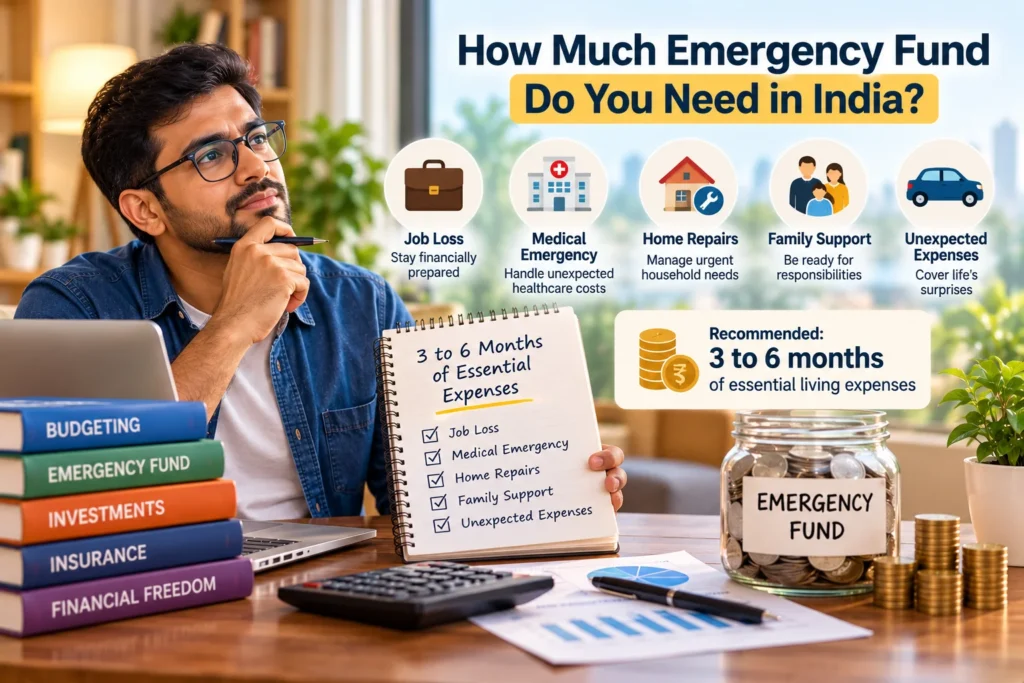
Imagine that your monthly home loan EMI is ₹18,000. Your family also needs ₹20,000 for other essential expenses. Your total essential monthly requirement is ₹38,000.
If you lose your income, you may need to continue paying the EMI and meeting household expenses while looking for another job.
These are illustrative targets. Your actual requirement may differ depending on employment stability, insurance, dependants, other reliable sources of income and access to financial support. An emergency fund can help prevent a temporary income interruption from becoming a long-term financial problem.
How can you build it on one salary?
- Start with an initial target, such as one month of essential expenses. Then gradually build towards three to six months or another suitable amount.
- If your budget permits, automate a monthly transfer to a separate savings account shortly after receiving your salary.
- Keep the reserve in a form that is relatively stable and accessible. Do not rely entirely on volatile investments to pay your next EMI.
- If you already have significant high-interest debt, consider how to balance debt repayment with maintaining a basic emergency reserve. The best sequence depends on your circumstances.
6. Manage Family Expenses Without Making Life Miserable
Budgeting should not mean removing every enjoyable activity from family life. A plan that is too restrictive can become difficult to sustain. The objective is to spend intentionally, not to feel guilty about every purchase.
Plan groceries before visiting the supermarket
Create a weekly meal plan and shopping list. Check what is already available at home before buying more. This can reduce food waste and unnecessary purchases.
Separate wants from genuine needs
Before making a major purchase, ask whether it is essential, whether it can wait and whether it fits the monthly budget. For example, replacing a damaged appliance may be necessary. Buying a new device simply because a newer model is available may not be.
Plan for festivals and annual expenses
Indian households often have expenses that do not occur every month, such as festival purchases, school admissions, annual insurance premiums, vehicle maintenance and family travel. If you expect to spend ₹24,000 on predictable annual expenses, setting aside ₹2,000 every month can help prepare for those payments. This is a planned-expense fund rather than an emergency fund.
Discuss financial goals as a family
When only one person earns, it can be easy for the entire financial responsibility to fall on that person. Discuss major expenses, savings targets and financial priorities with your spouse or family members where appropriate. A shared understanding can reduce misunderstandings and help everyone work towards the same goals.
7. Protect Your Family With Appropriate Insurance
A home loan is a long-term financial commitment. If the sole earning member becomes unable to work or dies, the family may face both a loss of income and an ongoing loan obligation. Insurance can form part of a wider financial protection plan.
Health insurance
Can help cover eligible medical expenses according to the policy terms. Review the sum insured, exclusions, waiting periods, room limits where applicable, and other conditions. Employer-provided coverage can be useful, but consider whether it would remain available if you changed jobs or stopped working.
Term life insurance
For a person whose income supports a family, suitable term cover may provide financial support to dependants if the insured person dies during the policy term. The required cover depends on liabilities, family expenses, dependants' future needs, existing assets and other resources. Do not choose coverage solely because it equals the home loan amount.
Disability and income protection
Where suitable products are available, review whether you have protection against disability or loss of income due to illness or injury. Understand what each policy actually covers. Insurance is not a substitute for an emergency fund, and exclusions and claim conditions matter.
8. What Should You Do When Your Salary Increases?
A salary increase can make a meaningful difference to your family's financial position, but only if some of the additional income is directed towards your goals.
Suppose your take-home salary rises from ₹50,000 to ₹60,000. You now have an additional ₹10,000 each month. Instead of allowing all of it to become additional lifestyle spending, you could consider an allocation such as:
| Use of additional income | Monthly amount |
|---|---|
| Increase long-term investments | ₹4,000 |
| Build emergency savings or planned reserves | ₹3,000 |
| Additional home loan principal repayment | ₹2,000 |
| Additional family spending | ₹1,000 |
| Total increase allocated | ₹10,000 |
If your emergency fund is incomplete, you may prioritise it over prepayment. If you have costly debt, repayment may deserve greater attention. If your current budget is insufficient for essential family needs, those needs come first.
The principle is to decide how to use a salary increase before the additional spending becomes habitual.
9. Five Financial Mistakes to Avoid When Managing Everything on One Salary
Taking the maximum home loan you qualify for
Loan eligibility does not necessarily reflect the actual cost of supporting your family. Consider your essential expenses, emergency savings and future commitments before choosing an EMI you will have to pay for years.
Investing every spare rupee while keeping no cash reserve
Long-term investments can fluctuate. If an emergency occurs, you may be forced to sell at an unfavourable time or borrow money. Maintain accessible savings appropriate to your situation.
Using credit cards to cover recurring budget shortfalls
If monthly expenses regularly exceed income, borrowing may hide the underlying problem and create additional interest costs. Review the budget and identify whether the issue is high fixed expenses, debt, insufficient income or avoidable spending.
Ignoring small recurring expenses
Subscriptions, frequent food deliveries and unplanned purchases can add up over time. Review recurring payments periodically and keep those that genuinely provide value.
Treating home ownership as the only financial goal
A fully repaid home is valuable, but retirement, healthcare, education and other financial needs also matter. Plan for your future rather than assuming that repaying the home loan will solve every financial challenge.
10. A Simple Monthly Financial Routine for One-Income Families
A consistent routine can make household finances easier to manage.
On salary day
- Confirm your take-home salary.
- Pay or set aside the amount required for your home loan EMI.
- Allocate money for essential household expenses.
- Transfer the planned amount to emergency savings.
- Make your planned investment contribution if your budget permits.
During the month
- Track spending against the budget.
- Avoid unnecessary borrowing.
- Keep receipts or records for major household expenses.
- Use your planned-expense fund for predictable irregular costs.
At the end of the month
- Compare actual expenses with your budget.
- Identify categories where spending exceeded expectations.
- Check whether you maintained your planned savings.
- Adjust next month's budget if essential costs have changed.
Review your emergency fund, outstanding loans, investments, insurance coverage and upcoming financial goals. This routine need not take more than a little time each month. Its value comes from making financial decisions deliberately rather than reacting to every bill.
Frequently Asked Questions
1. Can I manage a home loan and family expenses on a ₹40,000 salary?
It may be possible, but it depends heavily on the EMI, rent or other housing costs, family size, location, dependants and existing debt. Calculate essential expenses first. If the EMI leaves too little for necessities and savings, review your budget and loan options before taking on further financial commitments.
2. How much of my salary should go towards a home loan EMI?
There is no universal percentage that guarantees affordability. Calculate the EMI as a proportion of take-home income, then assess what remains after other essential expenses and debt repayments. A seemingly manageable EMI may still be difficult if your family has substantial financial responsibilities.
3. Should I stop SIPs until my home loan is repaid?
Not necessarily. If your emergency savings are adequate, your debt is manageable and your budget allows it, continuing suitable long-term investments can help you prepare for goals that extend beyond your home loan. If money is tight, prioritise essential expenses, basic financial protection and expensive debt.
4. Is it better to prepay a home loan or invest in mutual funds?
The decision depends on the effective loan cost, investment risks, taxes, time horizon, liquidity and your financial priorities. Loan prepayment can reduce interest costs, while mutual fund returns are uncertain. Compare the actual alternatives rather than assuming investments will outperform the loan interest rate.
5. How much emergency fund should a family with a home loan maintain?
A common planning target is three to six months of essential expenses, including the home loan EMI. Families relying on one income may prefer a larger reserve if finding replacement income could take considerable time.
6. Should I take another loan to manage family expenses?
Borrowing to cover recurring household shortfalls can create a debt cycle. Before borrowing, identify why the budget is insufficient. Review expenses, repayment commitments and potential income options. If you are already struggling with debt, seek appropriate financial counselling before taking on more obligations.
7. How can I save for retirement while paying a home loan?
Start by estimating your retirement needs and reviewing your current savings. If your budget allows, maintain a sustainable contribution towards suitable long-term investments while paying your regular EMI. Increase contributions as income grows and review your plan periodically.
8. What should I do if I cannot pay my home loan EMI?
Contact your lender as early as possible and discuss the available options before arrears accumulate. Review your household budget, identify accessible savings and understand the consequences of any proposed restructuring or change in tenure. Do not assume that missed payments can be ignored without consequences.
Balance Today's Responsibilities With Tomorrow's Security
Managing a home loan, family expenses and investments on one salary is not easy. Every financial decision can feel connected to another responsibility. Paying the EMI is important, but so is keeping food on the table, protecting your family, handling emergencies and preparing for the future.
The most practical approach is to start with a clear budget. Understand your take-home salary, account for essential expenses, maintain an emergency reserve and invest at a level you can sustain. Review your home loan periodically, but avoid sacrificing all your accessible savings simply to repay it faster.
When your income increases, use part of that increase to strengthen your financial position rather than allowing every additional rupee to become a new expense.
You do not need a perfect financial plan to begin. You need a realistic plan that your family can follow consistently. Over time, these habits can help you manage debt more confidently, reduce financial stress and work towards a future in which your family has greater financial flexibility.
Take Control of Your Family's Financial Future
A home loan is only one part of your financial life. Building an emergency fund, managing monthly expenses, understanding debt and investing for long-term goals are equally important. Explore our personal finance guides to learn how to create a monthly budget, calculate your emergency savings target and make more informed decisions.
Explore Our Financial Guides →